
Precision Automotive Plastic Injection Moulding And Tooling Solutions
Leave a message
Plastic components are found in many parts of modern vehicles, including dashboard housings, door panels, mounting clips, and functional assemblies. Although some components have relatively simple shapes, their production still requires careful attention to dimensions, material properties, surface finish, and installation requirements.
Choosing the right automotive plastic injection moulding process involves more than selecting a suitable plastic material. The mold must match the part's design and structural requirements, while the material needs to withstand the conditions in which the component will be used. Production volume, assembly methods, and tooling costs also need to be considered.
Therefore, custom automotive injection moulding projects require a clear understanding of the component's design and intended use. Mold structure, material selection, and processing conditions all play a part in determining the final product quality and production cost.
An Overview of Automotive Plastic Part Production
Automotive plastic injection moulding is a process used to manufacture plastic components for vehicles. Plastic pellets are heated inside an injection molding machine until they melt. The machine then injects the material into a mold cavity, where it cools and takes the required shape. Once the part has solidified, the mold opens and the component is removed.
This process is suitable for producing parts with different geometries and functional features. Common examples include dashboard components, door panels, headlamp housings, bumpers, interior clips, and various under-the-hood components.
Compared with many conventional manufacturing methods, injection molding allows manufacturers to produce complex shapes with consistent dimensions across multiple production cycles. It also supports different engineering plastics, making it suitable for both visible automotive components and functional parts.

Material and Mold Design for Automotive Components
Automotive components rarely share exactly the same manufacturing requirements. A decorative interior panel, for example, has different material and surface expectations from a functional clip or an engine compartment component. Therefore, each project needs to be evaluated according to its intended application.
1. Selecting the Right Plastic Material
Material selection affects the strength, weight, dimensional stability, and service life of an automotive component.
ABS is commonly used for interior components because it offers a balance of impact resistance and surface quality. Polypropylene (PP) is often considered for lightweight parts, while PA66 is suitable for certain functional components that require greater mechanical strength and heat resistance.
However, these materials are not interchangeable in every application. Engineers also need to consider operating temperature, chemical exposure, moisture absorption, and the component's installation environment.
Selecting a suitable material at the beginning of an automotive plastic injection moulding project can help avoid unnecessary adjustments during tooling and production.
2. Mold Structure and Dimensional Requirements
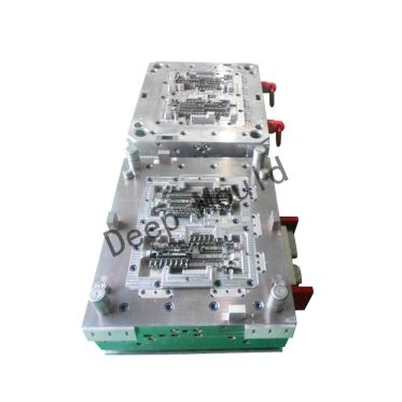
Automotive plastic parts often include mounting holes, ribs, clips, grooves, and other details that connect them to surrounding components. These features can make mold design more complicated, particularly when the part contains undercuts or side openings.
Depending on the part geometry, the mold may require sliders, lifters, interchangeable inserts, or specially arranged cooling channels. Engineers also need to account for material shrinkage, draft angles, wall thickness, and parting line positions.
For example, an automotive clip mold may need a slider mechanism to form side-locking features. For larger interior components, cooling balance and mold deformation require closer attention to help maintain dimensional consistency.
These details are important in precision automotive plastic injection moulding, especially when molded parts need to fit with other components during vehicle assembly.
3. Surface Finish and Appearance
The appearance of a molded part depends on both the plastic material and the mold surface. Automotive interior components may require a smooth, matte, or textured finish, depending on their position and design.
Manufacturers can create different surface effects through mold polishing, texturing, and other surface treatments. At the same time, molding conditions need to remain stable to reduce defects such as sink marks, flow marks, weld lines, and uneven surfaces.
For visible components, it is worth confirming the required finish and acceptable appearance standards before mold manufacturing begins. This helps both parties understand the inspection requirements during production.
Injection Molding Applications in Automotive Manufacturing
Automotive plastic injection moulding is widely used because it supports repeatable production and a broad range of component designs.
Several characteristics make the process suitable for automotive manufacturing:
• Consistent part dimensions: A properly designed mold helps maintain dimensional consistency across production batches.
• Complex geometries: Features such as ribs, mounting points, clips, and curved surfaces can be incorporated into molded components.
• Suitable for different production volumes: Injection molding can support both ongoing production and larger orders once the tooling and process parameters are established.
• Material options: Manufacturers can select plastics according to mechanical strength, temperature resistance, weight, and appearance requirements.
• Part integration: Certain designs can combine multiple functional features into one component, which may reduce the number of separate parts required for assembly.
However, the actual benefits depend on the component design, mold investment, material selection, and expected production quantity. Therefore, manufacturers should evaluate the complete project rather than consider the unit molding cost alone.
Custom Automotive Plastic Injection Moulding Services at Deep Mould
Established in Dongguan, China, in 2016, Deep Mould specializes in custom mold manufacturing and the production of plastic and metal components for automotive and other industrial applications.
Our manufacturing capabilities cover injection mold design and production, plastic injection molding, CNC machining, 3D printing, and vacuum casting. We also handle secondary operations, including EDM, wire cutting, grinding, polishing, and precision assembly, depending on the requirements of each project.
For automotive applications, we manufacture custom interior and exterior plastic parts, clips, functional housings, and injection mold tooling. Our engineers can evaluate projects based on 2D drawings, 3D models, physical samples, or technical specifications to understand the part structure and manufacturing requirements.
If you are sourcing custom automotive plastic components or need an injection mold manufacturer in China, share your drawings or project requirements with Deep Mould. Our team can review the details and discuss suitable tooling and production options.